

No cost
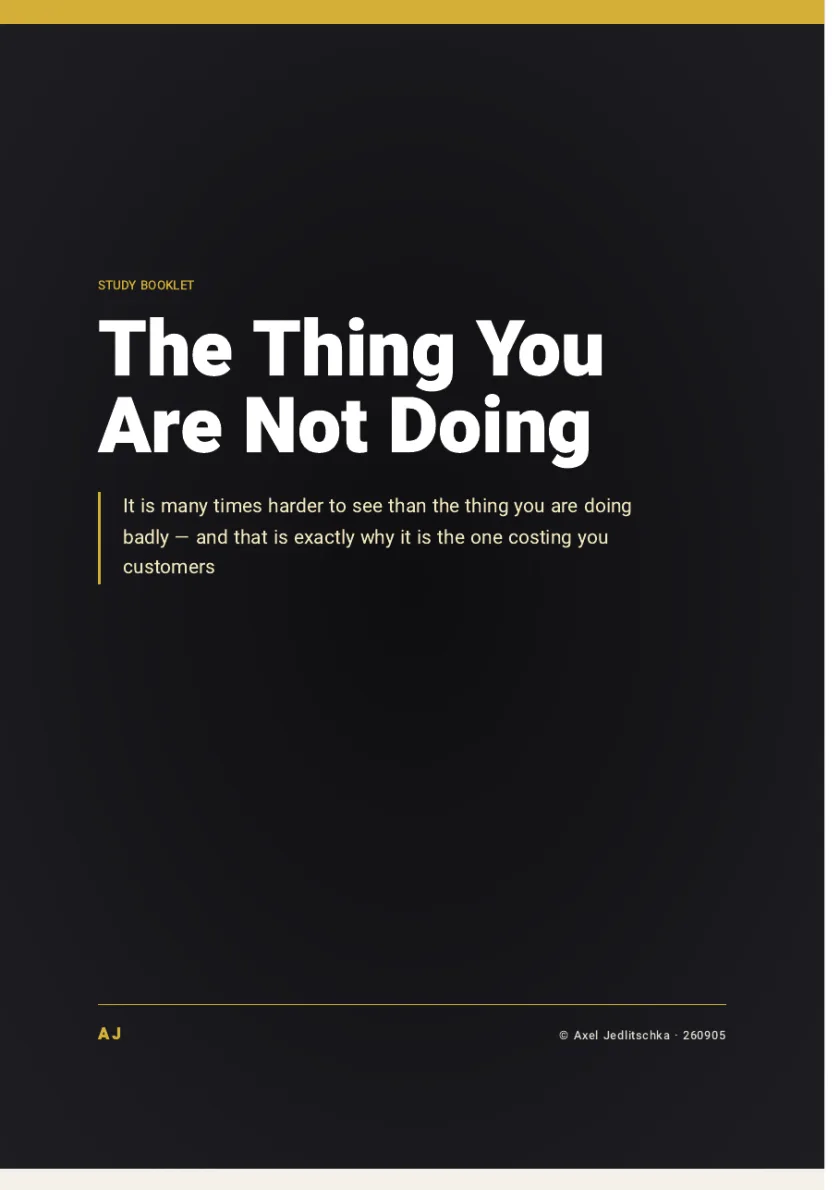
The Thing You Are Not Doing
- What you look for
- What is supposed to happen every week and did not
- When nothing changes
- Turn the question round: what was never done at all
- Once you've fixed it
- A check date in the diary, and five real cases
If you also say “We worked hard on it and nothing changed”, you're not alone.
Could the problem be not in what was done badly, but in what was never done at all? A mistake shouts: a customer complains, something breaks, a number drops. A thing not done is silent. There is nobody to complain about a call that was never made.
And it costs you, because people work frantically on the wrong thing. Hard work that changes nothing points at a wrong diagnosis.
And even when something is fixed, the moment you decided what to do feels like the end, and it is the middle. A correction gets made, and then people “fail to ensure that it is corrected.”

I built work apps for myself and for the workplaces where I worked, and also automations that streamline work processes.
So I am against “We worked hard on it and nothing changed”. Hard work that changes nothing points at a wrong diagnosis. What is supposed to happen every week should be written down, and then you can see what did not happen. That list will tell you more than any report.
Axel Jedlitschka
Know why the missing thing is the hardest thing to spot, and why that is not your fault.
Recognise a pattern: people working hard on the wrong problem, because the right one is invisible.
Build a diagnostic tool made entirely of what is not happening.
Understand why you are the person least able to see the problem in your own business, and what to do about it.
Tell “the team knows the procedure” apart from “the team performs it”.
The booklet's rule: “one can safely conclude the Why is an omission and look for things that should be there and aren't.” Here “Why” is the booklet's word for the real cause, and an “absence list” is the tool for finding it: a list of what is supposed to happen and did not. If you searched and found nothing, do not search harder in the same place. Turn the question round: not “what was done wrong”, but “what was never done at all”.
In the evening there is no smoke from the chimneys, at night there are no lights, and at dawn there are no dogs. Three lines, and from them you can conclude the place is deserted, without seeing a single thing that did happen.
The Thing You Are Not Doing · a booklet by Axel Jedlitschka
Two lenses: one that sees what is not happening, and one that tells knowing apart from doing.
No cost
48 pages, 10 chapters, an absence list and five exercises
Price: No costNo credit card, and no chapter is held back for payment
The booklet is yours right away, at no cost. You only get marketing messages if you tick the box, and you can unsubscribe at any time.
As soon as you leave your details, a thank-you page opens with a button to download the booklet.
By Axel Jedlitschka
There is no purchase and no payment here, so there is nothing to cancel. You can withdraw your consent to marketing messages at any time.
You leave your details, and a thank-you page opens right away with a button to download the booklet as a PDF.
Yes. No credit card, and no chapter is held back for payment.
If you take one thing away from the booklet, take Chapter 3. It has a complete diagnostic method, and it is built entirely out of what is missing.
Your details are used to send you the booklet and to follow up on it. Marketing messages are sent only if you ticked the consent box, and you can unsubscribe at any time. You can also ask to see, correct or delete your details.
The booklet is complete, and no chapter in it is held back for payment. Every quote in it is anchored to a line in the source: 53 anchors, checked in the original Hebrew edition.
You do not inspect everything all the time. You watch a few numbers, and you go in only when one of them moves. And the weekly mark takes two minutes.
A question about the booklet: send a message on Instagram to @theonlyaxelj.
You can go looking again for what was done wrong, or you can write down seven actions that are supposed to happen every week, and in a week mark what did not.
A 48-page PDF booklet: 10 chapters, an absence list and five exercises, at no cost.
Price: No costNo credit card
The booklet is yours right away, at no cost. You only get marketing messages if you tick the box, and you can unsubscribe at any time.
No cost
Get the booklet